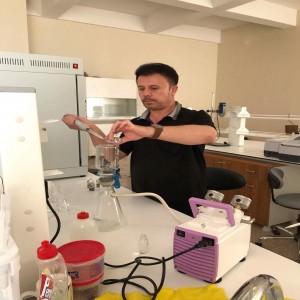
Locally sourced crude oil from Iraqi Kurdistan contains recalcitrant organosulfur compounds that impair air quality, corrode refinery equipment, and hinder compliance with fuel sulfur regulations. This study isolated a Pseudomonas sp. closely related to the Pseudomonas aeruginosa from oil-contaminated soil near Kashy Refinery (Duhok Province, Kurdistan Region, Iraq) and evaluated its biodesulfurization potential as an environmentally friendly alternative to hydrodesulfurization. Batch experiments were conducted at 34 °C and atmospheric pressure using mineral salts medium supplemented with 1%, 3%, and 5% (v/v) Tawki crude oil. The highest sulfur removal efficiency of 83.33% was obtained at 1% (v/v) crude oil after 10 days of incubation, as determined by X-ray fluorescence, with visible emulsification and sediment formation indicating active microbial transformation. The observed decrease in total sulfur content, concurrent sulfate accumulation in the aqueous phase, and process simulations representing dibenzothiophene (DBT) conversion to 2-hydroxybiphenyl (2-HBP) and sulfate were consistent with a sulfur-selective, 4S-like route but did not provide direct genetic confirmation of the canonical 4S pathway. These findings highlight the potential of indigenous Pseudomonas populations for regionally tailored biodesulfurization strategies that can support cleaner fuel production and reduced sulfur emissions in Iraqi Kurdistan, while emphasizing the need for future work on sulfur-free media, resting-cell assays, and characterization of 4S-pathway genes.
See More
See Less